
Thursday, September 27, 2012


Monday, September 24, 2012
Onbereikbaar
Een op de tien bewoners van een tehuis komt nooit meer buiten. Wat voor ons zo vanzelfsprekend is
- een wandelingetje naar de brievenbus of een ommetje door het park - is voor deze ouderen eerder uitzondering dan regel. Zij zijn afhankelijk van ons zorgstelsel dat door aanhoudende bezuinigen onder druk staat.
In mijn afstudeerproject heb ik een serie boeken gemaakt. Elk boek bevat een wandeling die iedereen dagelijks zou kunnen maken. De titels van de boeken verwijzen naar de kosten (bijvoorbeeld: " twee euro en zevenendertig eurocent) voor de begeleiding om de in beeld gebrachte wandeling te realiseren.


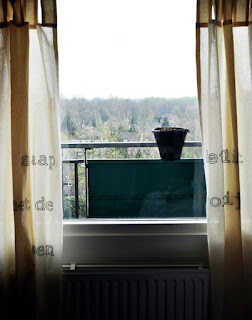


- een wandelingetje naar de brievenbus of een ommetje door het park - is voor deze ouderen eerder uitzondering dan regel. Zij zijn afhankelijk van ons zorgstelsel dat door aanhoudende bezuinigen onder druk staat.
In mijn afstudeerproject heb ik een serie boeken gemaakt. Elk boek bevat een wandeling die iedereen dagelijks zou kunnen maken. De titels van de boeken verwijzen naar de kosten (bijvoorbeeld: " twee euro en zevenendertig eurocent) voor de begeleiding om de in beeld gebrachte wandeling te realiseren.


Een visuele handleiding voor mijn dementerende opa.


Wednesday, September 12, 2012


Sunday, September 9, 2012

Friday, August 24, 2012
Gibbs Farm

Gibbs Farm is an unusual setting for a sculpture collection. The North Auckland property is dominated by the Kaipara Harbour, the largest harbour in the Southern hemisphere. The harbour is so vast it occupies the whole western horizon; and it is very shallow, so when the tide goes out, the shallows are exposed for several kilometres and the light shimmies and bounces off it across the land. Equally, it is the forecourt to the prevailing westerly weather that sweeps, sometimes vehemently, across the land. Everything in the property flows towards and eventually into the sea; and every work contends in some way with the slide seaward.
The flow of the land, the immense body of water, the wide harbour flats and the assertive variety of the elements have all imposed themselves on the artists. Gibbs acknowledges that “the challenge for the artists is the scale of the landscape; it scares them initially” and demands something more from them. Walking the land visitors can appreciate how each artist has come to terms in their own way with the gravitational pull that is exerted on everything as the mountains roll into hills and slide into gullies and slope down towards the wide flat expanse of the Kaipara harbour.
After nearly twenty years Gibbs Farm includes major works by Graham Bennett, Chris Booth, Daniel Buren, Bill Culbert, Neil Dawson, Marijke de Goey, Andy Goldsworthy, Ralph Hotere, Anish Kapoor, Sol LeWitt, Len Lye, Russell Moses, Peter Nicholls, Eric Orr, Tony Oursler, George Rickey, Peter Roche, Richard Serra, Kenneth Snelson, Richard Thompson, Leon van den Eijkel and Zhan Wang. Most works in the collection are commissioned; and commissioning new works rather than buying from an exhibition involves the satisfaction of dealing with the artists, as Gibbs comments “they’re interesting because they’re winners, tough, ambitious”.
—Rob Garrett


Gibbs Farm
Ron Galella
Ron Galella
Paparazzo Extraordinaire!
8 june - 22 august 2012
Paparazzo Extraordinaire!
8 june - 22 august 2012

Jackie Onassis
This summer Foam presents a major exhibition of work by Ron Galella, pioneer of paparazzi photography. The exhibition features photos of stars including Mick Jagger, Jackie Onassis, Greta Garbo, Brigitte Bardot, Marlon Brando, Andy Warhol, Sean Penn, Elizabeth Taylor, Frank Sinatra, Penélope Cruz and many more. These photos have appeared in magazines such as Life, Time, Rolling Stone, Vogue and Vanity Fair.
Ron Galella (1931, The Bronx, New York) started his career in the US Air Force. After returning from Korea he attended the Art Center College of Design in Los Angeles and graduated in 1958 as photo journalist. In his spare time he started photographing stars attending premières. This became his true passion.
Galella typically doesn't view his 'victim' through his lens; in order to really make contact, he looks right into the star's eyes. He is also lightening fast, the essence of what he calls the 'Art of Paparazzi'. By the time the stars have told him 'no', he can often do what they have asked - in the meantime, he's already taken two photos. Galella's method is seldom without humour. Following a confrontation with Marlon Brando he bought a helmet with the words 'Paparazzi Ron'.
October 1971 was an important date in Galella's career. It was a month in which he frequently photographed Jacqueline Kennedy Onassis. After encountering the photographer for the umpteenth time, the widow of assassinated US President John F. Kennedy and wife, at that time, of shipping magnate Ari Onassis took off running into New York's Central Park. This photo of her on the run has become a 'Jackie icon'. Galella's Jackie-obsession ended with his arrest and a notorious court case that revolved around the question of how far a photographer could intrude on the privacy of a celebrity. For some, however, the photos of Jackie Onassis also provided considerable inspiration, such as for Tom Ford, former designer at fashion house Gucci.
Although Galella did not invent the term paparazzi, he is the personification of the word. He redefined the relationship between celebrity and photographer. Jackie Onassis clearly dreaded the cheeky photographer, but other stars were glad to see him or were resigned to his presence. They realised that Ron Galella was a crucial link in stars' popularity, satisfying the general public's voyeurism and stimulating magazine sales.

Andy Warhol
"My idea of a good picture is one that's in focus and of a
famous person doing something infamous. That's why my favorite
photographer is Ron Galella". (Andy Warhol)

Sophia Loren

Madonna and Sean Penn
Stanley Kubrick at the EYE Amsterdam
21 June – 9 September 2012
A comprehensive exhibition on one of the most influential directors of the 20th century: Stanley Kubrick (1928-1999), the genius behind films such as Lolita, 2001: A Space Odyssey, A Clockwork Orange and The Shining.

Kubrick's films are both technically and artistically stunning. While content-wise, he often sought to be controversial. The exhibition is a co-production with the Deutsches Filmmuseum in Frankfurt and shows all aspects involved in the creation of Kubrick's films: from screenplays to storyboards, from set models to actual props, and from costumes to clips of the eventual films and documentaries. Parallel to the exhibition, EYE is staging a retrospective of Kubrick's films, from The Killer's Kiss (1955) to Eyes Wide Shut (1999). And via special programmes, such as debates, interviews and lectures, will be zooming in on both Kubrick's work and his driving force.


Subscribe to:
Posts (Atom)